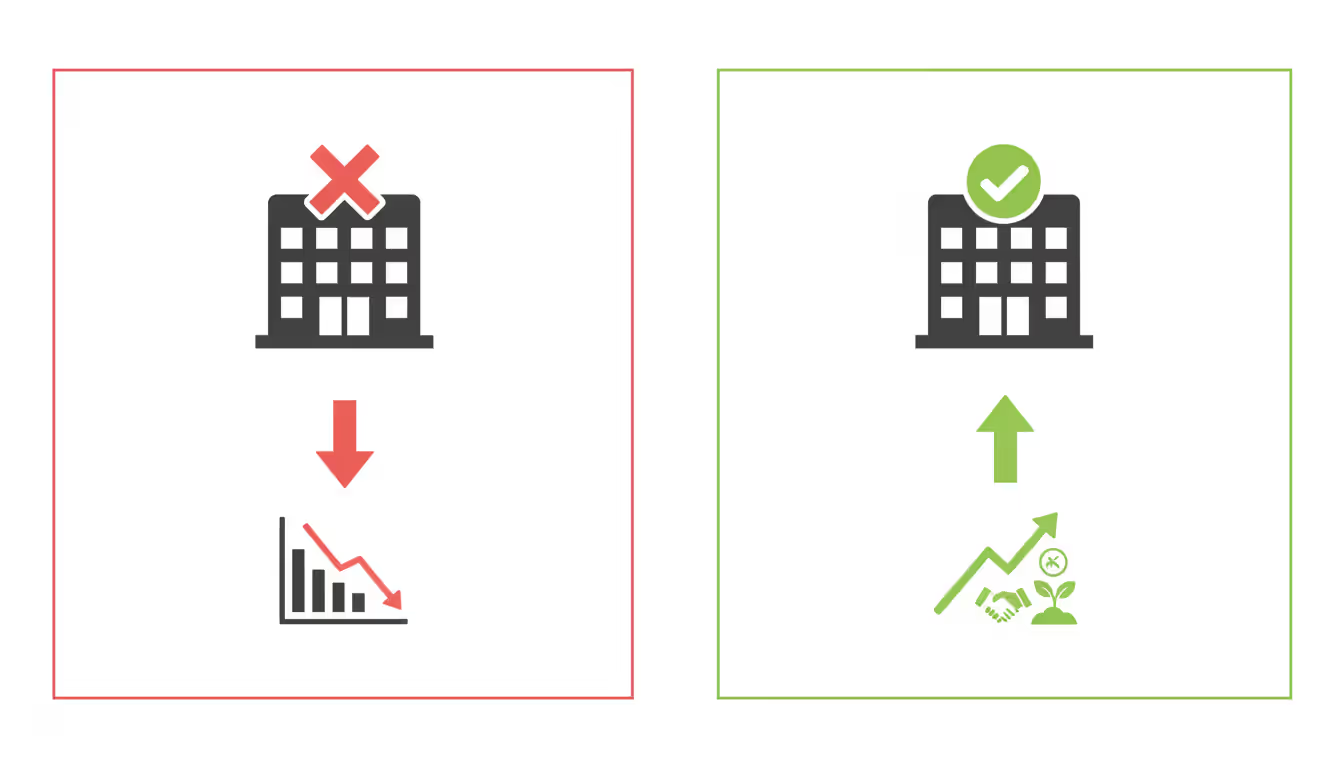
Most people think bankruptcy means shutting down and selling everything. That's not how Chapter 11 works. It's designed for restructuring—you keep running your business (or managing your personal finances) while renegotiating debts under court protection. Think of it as hitting the pause button on creditor collection while you craft a realistic payment plan everyone can live with.
The catch? It'll cost you serious money and take considerable time. You'll need $50,000+ for legal fees at minimum, and the process typically runs 12-24 months before you even get a plan approved. But if your business generates real value that would vanish in a fire sale, or you're an individual with millions in debt who doesn't qualify for simpler options, Chapter 11 might be your only realistic shot at financial recovery.
Here's what makes it different: you stay in control. The court watches over your shoulder, creditors get a say in your plan, but you're not handing the keys to a trustee who'll liquidate everything. You're negotiating a deal where creditors often accept partial payment because they know liquidation would give them even less.
What Is Chapter 11 Bankruptcy?
Think of Chapter 11 as a court-supervised negotiation between you and everyone you owe money. It's filed under Title 11 of U.S. bankruptcy code, and its whole purpose is reorganization rather than liquidation. You propose how much you'll pay each creditor, over what timeframe, and why this plan makes more sense than shutting down and selling off assets.
Here's how it contrasts with the other bankruptcy types:
Chapter 7 is the "liquidation chapter." A court-appointed trustee takes your stuff, sells it, pays creditors whatever the sale brings in (usually pennies on the dollar for business assets), and the business disappears. For individuals, you might discharge remaining debts, but you've lost non-exempt property. The doors close permanently.
Chapter 13 works only for individuals earning regular income with total debts under $2,750,000 (that's the 2026 threshold). You propose a 3-5 year repayment plan using your future income. It's straightforward, relatively cheap (maybe $4,000 in legal fees), and handles most consumer debt situations effectively. But corporations can't use it, and high-debt individuals exceed the limit.
Chapter 11 has no debt ceiling. Businesses of any size qualify. Individuals can use it too, though they rarely do because of the expense. You're restructuring—cutting debt obligations, extending payment terms, renegotiating contracts, maybe converting some debt to ownership equity.
Let me give you a concrete scenario. Say you own a commercial printing company with $8 million in debts: $3 million on equipment loans, $2 million to paper suppliers, $1.5 million in building leases you can't afford, $1 million to other creditors, and $500k in back taxes. Your equipment is worth maybe $5 million, the business has steady clients generating $6 million annual revenue, and you employ 85 people.
Author: Samantha Crowley;
Source: dynamicrangemetering.com
Chapter 7 would auction that equipment for perhaps $2 million (used printing presses don't command premium prices). After trustee fees and secured creditor claims, unsecured creditors might get 15 cents per dollar owed. Everyone loses their job. The business vanishes.
Chapter 11 lets you propose something like: reduce equipment loan principal to current market value ($5M becomes $3M), pay suppliers 50 cents per dollar over 5 years from operating revenue, reject the expensive building leases and move to cheaper space, restructure tax debt over 6 years. Your creditors vote on this plan. If they accept it (and often they do because they'll collect more than liquidation would bring), you keep operating, workers keep jobs, and you eventually pay off the restructured obligations.
The automatic stay kicks in the moment you file. All lawsuits stop. Foreclosures halt. Creditors can't call demanding payment. You get immediate relief from collection pressure while developing your reorganization strategy.
Who Can File for Chapter 11 Bankruptcy?
The bankruptcy code doesn't restrict Chapter 11 filing based on entity type or debt amount. Any business or individual can file. The practical question is: should you?
Chapter 11 for Businesses
Most Chapter 11 cases involve businesses—corporations, LLCs, partnerships, sole proprietorships. No upper debt limit exists, making it the only reorganization option for companies owing substantial amounts.
Why do profitable businesses file Chapter 11? Because they're not actually profitable once you factor in debt service. A restaurant chain might have locations generating strong sales, but lease obligations signed during optimistic expansion plans now consume all revenue. Operations are sound; the debt structure isn't sustainable.
Common business scenarios include:
Retail chains with long-term leases on underperforming locations they need to exit without triggering massive early termination penalties
Construction companies owed money on completed projects but facing mechanic's liens and bonding issues from one bad job
Healthcare providers with valuable patient relationships and equipment but crushing medical malpractice lawsuit settlements
Technology companies with promising products but premature debt loads from development costs
Franchisees making money on operations but drowning in franchisor fees and equipment financing
Small business owners should investigate Subchapter V, passed in 2019 and expanded since then. If your business debts stay under $7,500,000 (that's the 2026 inflation-adjusted cap), you qualify for this streamlined version. No creditors' committee gets appointed (saving you $50k-$200k right there). The timeline compresses to 90 days for filing your plan. A trustee gets assigned but usually facilitates rather than taking over operations. Total costs might run $30k-$75k instead of $150k-$300k. For qualifying small businesses, Subchapter V changed the game entirely.
Chapter 11 for Individuals
Personal Chapter 11 bankruptcy exists in a weird space. It's available but expensive enough that most people find better alternatives.
You'd consider individual Chapter 11 if you're over the Chapter 13 debt limit. That $2,750,000 threshold sounds high until you meet a real estate developer who personally guaranteed construction loans on three apartment buildings now worth less than the mortgages. Combined debt: $4.2 million. Personal assets: $1.8 million in equity plus retirement accounts. Income: $350k annually from property management and consulting.
Chapter 7 would liquidate the equity and discharge the deficiency debt—but you've lost everything you built. Chapter 13 won't accept the filing because debt exceeds limits. Chapter 11 lets you propose something workable: reduce mortgage debt to current property values ($3M instead of $3.8M), pay the remaining $1.4M over 7 years from income, keep the properties and continue building equity.
Other individual scenarios:
Physicians with multi-million dollar malpractice judgments exceeding their insurance
Entrepreneurs with personal guarantees on failed business debts
High-net-worth individuals with complex asset structures (multiple properties, business interests, trusts) that don't fit Chapter 13's simpler framework
Investors who borrowed heavily during market peaks and now face margin calls and deficiency judgments
The brutal reality: individual Chapter 11 cases easily cost $75k-$150k in legal fees alone. You'll need a bankruptcy attorney, probably a financial advisor to develop projections, maybe real estate appraisers or business valuation experts. Compare that to $4k-$6k for Chapter 13. Unless your debt truly exceeds the Chapter 13 cap or your asset situation demands Chapter 11's flexibility, the cost kills the benefits.
How the Chapter 11 Filing Process Works
Let me walk you through what actually happens when you file, because the process follows a specific sequence even though timelines vary wildly.
Petition Filing: Your attorney files the bankruptcy petition with the court, along with schedules documenting every asset you own, every debt you owe, your income sources, monthly expenses, and financial transactions from the past few years. Business cases include profit/loss statements, balance sheets, cash flow projections. The filing triggers the automatic stay instantly—creditors must stop all collection efforts immediately or face contempt charges.
Debtor-in-Possession Status: Unless the court finds serious fraud or mismanagement, you become the "debtor-in-possession" (usually shortened to DIP). You're still running the show. Your management team doesn't get replaced. But you now owe fiduciary duties to creditors, not just owners. Everything you do must consider creditor interests. The court can remove you and appoint a trustee to take over if you abuse this privilege, though it rarely happens.
First Day Orders: Within 24-48 hours of filing, you're asking the judge to approve emergency requests—paying employees (you can't skip payroll just because you filed bankruptcy), maintaining insurance coverage, continuing essential vendor payments, using cash that might technically be collateral for a lender. Courts grant most first-day motions because everyone understands the business needs basic operations to continue.
Creditors' Committee Formation: The U.S. Trustee's office (a Justice Department division overseeing bankruptcy cases) appoints an official committee of unsecured creditors, typically the seven largest. This committee hires lawyers and financial advisors—all paid from your bankruptcy estate—to negotiate with you and protect general creditor interests. They'll scrutinize your reorganization plan, propose modifications, maybe conduct their own investigation of what went wrong. Subchapter V cases skip this step, which is why they cost less.
Author: Samantha Crowley;
Source: dynamicrangemetering.com
Operating Period: Now you're running the business under bankruptcy court supervision. You file monthly operating reports showing every dollar in and out. Transactions outside "ordinary course of business" need court approval—selling equipment, borrowing money, paying old debts, settling lawsuits. Meanwhile, you're negotiating with creditors, hopefully cutting costs and returning to profitability.
Disclosure Statement Preparation: Before proposing your actual reorganization plan, you must draft a disclosure statement explaining your financial condition, what caused the bankruptcy, industry conditions, how the proposed plan works, and why creditors should accept it. This document often runs 50-150 pages. The court must approve it as containing "adequate information" before you can even solicit votes.
Plan of Reorganization Development: This is where Chapter 11 happens. Your plan classifies creditors into groups—secured lenders get their own class, priority creditors (taxes, wages) get another class, general unsecured creditors form another, and equity holders are the final class. Each class learns what they'll receive: maybe secured debt gets reduced to collateral value with extended payment terms; maybe unsecured creditors receive 40 cents per dollar over 5 years; maybe equity holders get nothing unless they contribute new money.
Plans might reject unfavorable contracts (getting out of expensive leases), assume profitable contracts (keeping good vendor relationships), sell non-core assets, or restructure the business into separate divisions. The possibilities are endless as long as you follow bankruptcy code requirements.
Creditor Voting: Each class votes on whether to accept your plan. Approval requires two thresholds: majority in number (at least half the creditors voting) AND two-thirds in dollar amount (representing at least 66.67% of claims voting). Classes getting paid in full don't vote—they're "unimpaired." Classes getting nothing don't vote either—they're presumed to reject.
If every voting class accepts, you're golden. If some classes reject but at least one impaired class accepts, you can pursue a "cramdown"—forcing the plan through over objections if you prove it treats everyone fairly according to bankruptcy code priority rules.
Confirmation Hearing: The judge holds a hearing where objectors can argue why your plan shouldn't be approved. The court examines whether: (1) you proposed the plan in good faith, (2) it's feasible (you can actually make the payments), (3) it complies with bankruptcy code provisions, and (4) it treats creditors fairly. If the judge says yes, the plan gets confirmed and becomes a binding contract.
Plan Implementation: Now you execute what you promised. You make quarterly payments to the plan administrator who distributes money to creditors. You operate according to plan terms. This phase typically lasts 3-5 years. Once you've completed all required payments, remaining dischargeable debts disappear and the case closes.
Chapter 11 Reorganization: Key Steps and Timeline
Understanding the mechanics is one thing. Grasping the practical realities of reorganization is another.
Being a debtor-in-possession creates strange dynamics. The same management team that led the company into bankruptcy now runs it for creditors' benefit. Some creditors will distrust you automatically. You need to prove through transparent communication and realistic proposals that you're not trying to pull a fast one. Hide problems, propose fantasy growth projections, or continue the same poor decisions that caused the bankruptcy, and you'll face motions to appoint a trustee or convert the case to Chapter 7 liquidation.
Running operations during bankruptcy feels like performing surgery on yourself while running a marathon. Vendors may refuse credit terms and demand cash on delivery. Key employees might jump ship fearing the business will fold. Customers with long-term contracts worry whether you'll fulfill obligations. You're managing all this while attending court hearings, preparing reports, meeting with creditors' committee representatives, and developing a reorganization plan.
The reorganization steps involve constant negotiation. Secured creditors wield substantial power because they can ask the court for relief from the automatic stay if their collateral loses value without adequate protection. Priority creditors (especially tax authorities) must receive full payment over time unless they agree otherwise. Unsecured trade creditors typically accept 30-60 cents per dollar because they know liquidation would yield 10-20 cents per dollar.
Developing a feasible plan demands brutal honesty about your finances. Courts reject plans built on wishful thinking. I've seen cases where retailers projected 25% revenue growth when their industry was contracting. The judge shot it down immediately. But show modest 4-6% growth backed by concrete strategies—new marketing initiatives with budgets, cost reductions with specific line items, customer contracts actually signed—and courts will consider it seriously.
Timelines depend entirely on case complexity. Subchapter V cases for small businesses might confirm plans in 6-10 months because there's no creditors' committee, shorter deadlines, and simplified procedures. A straightforward traditional Chapter 11 with cooperative creditors takes 15-20 months. Add litigation over asset valuations, disputes among creditor classes, or operational complications, and you're looking at 3-4 years easily. Massive cases with multiple subsidiaries and international operations can stretch 5-7 years.
During this period you're paying regular operating expenses, quarterly U.S. Trustee fees, professional fees for your attorneys and the committee's attorneys, and often "adequate protection payments" to secured lenders (monthly payments protecting their collateral value while the case proceeds).
The exclusivity period gives debtors the first shot at proposing a plan—initially 120 days, potentially extended to 18 months. This prevents creditors from immediately filing competing liquidation plans. But exclusivity also pressures you to develop something viable before creditors lose patience.
Author: Samantha Crowley;
Source: dynamicrangemetering.com
Costs and Requirements of Filing Chapter 11
Let's talk about money, because Chapter 11 costs eliminate it as an option for many businesses and individuals who might otherwise benefit.
Court filing fees are $1,738 as of 2026—barely worth mentioning compared to everything else. Attorney fees start around $50,000 for the simplest cases and routinely hit $150,000-$300,000 for mid-sized businesses with moderate complexity. Complex cases involving litigation, multiple business entities, or contentious creditor fights can exceed $500,000 in legal fees. Every one of those fees requires court approval, but judges understand that competent representation isn't optional in bankruptcy.
Creditors' committee professionals add another $50,000-$200,000 or more—paid from your estate, not by the creditors. The committee hires its own bankruptcy attorneys and sometimes financial advisors or industry consultants to evaluate your plan. You're funding the team negotiating against you.
U.S. Trustee quarterly fees start at $325 for estates with minimal disbursements but scale up to $250,000 annually for large cases with substantial quarterly payments. These fees are statutory—you don't negotiate them.
If the court appoints a trustee instead of letting you remain as debtor-in-possession (happens in maybe 5-10% of cases involving fraud or gross mismanagement), add trustee compensation and their professionals' fees on top of everything else.
You need ongoing financial management throughout the case. Monthly operating reports detail every dollar coming in and going out—these take staff time or require paying a bookkeeper. You maintain insurance, pay current taxes, meet payroll, and comply with various court orders. Many businesses hire turnaround consultants or chief restructuring officers to guide the process, adding $10,000-$50,000+ monthly.
The practical floor for viable Chapter 11 is a business generating at least $150,000-$250,000 annual revenue with a realistic path to profitability once debt service decreases. Below that threshold, administrative costs consume too much of your resources. You spend $100,000 on the bankruptcy when your annual profit potential is only $75,000—that math doesn't work.
Subchapter V changed the equation for small businesses. Total costs typically run $25,000-$75,000 because there's no creditors' committee and the process moves faster. This makes Chapter 11 accessible to businesses that couldn't justify traditional Chapter 11 expenses.
Bankruptcy Chapter Comparison
Feature
Chapter 7
Chapter 11
Chapter 13
Eligible Filers
Any individual or business entity
Any individual or business (no restrictions)
Only individuals with regular income
Debt Ceilings
No limits
Traditional: none; Subchapter V: $7.5M business debt
$2.75M combined secured and unsecured
Average Total Cost
$1,500-$4,000
Traditional: $75k-$500k+; Subchapter V: $25k-$75k
$3,500-$6,000
Typical Duration
4-6 months
Subchapter V: 6-12 months; Traditional: 12-24 months to plan confirmation; 3-5 years implementation
36-60 months total
What Happens to Assets
Non-exempt property sold by trustee; proceeds distributed
Assets retained while debts restructured per plan
Assets kept if plan payments current
Debt Discharge Timing
Most unsecured debts eliminated within months
Discharged after completing all plan payments
Remaining balance discharged after 3-5 years
Ideal Situations
Individuals with few assets and no repayment capacity; businesses closing permanently
Operating businesses worth more alive than liquidated; individuals over Chapter 13 limits
Wage earners with steady income, manageable debt, wanting to save home/car
Advantages and Disadvantages of Chapter 11 Protection
Every bankruptcy option involves trade-offs. Chapter 11's benefits are substantial, but so are its drawbacks.
Benefits of Chapter 11
You Keep Operating: This matters enormously. Employees don't lose jobs. Customer relationships survive. Vendor networks stay intact. The business maintains goodwill, reputation, and going-concern value that evaporates in liquidation. A printing company worth $5 million as an operating business might fetch $1.5 million in an auction of its equipment.
Flexible Debt Restructuring: Chapter 11 enables creative solutions unavailable elsewhere. You can reduce secured debt to current collateral value through cramdown. Unsecured debt gets partially discharged—creditors accept 40 cents per dollar instead of 100. Payment terms extend from immediate demands to 5-year schedules. Some creditors might accept equity ownership instead of cash payments. You can reject unprofitable contracts and leases while keeping favorable ones.
Author: Samantha Crowley;
Source: dynamicrangemetering.com
Automatic Stay Protection: The stay stops all collection activities immediately. Foreclosures halt. Lawsuits pause. Creditor harassment ends. You get breathing room to develop strategy without fighting off individual collection actions simultaneously.
Better Creditor Recovery: Counterintuitively, creditors often collect more through Chapter 11 than Chapter 7 liquidation. A functioning business generates revenue that can pay creditors over time. Liquidation auctions typically yield 10-30 cents per dollar for business assets like equipment, inventory, and accounts receivable. A reorganization plan paying 50 cents per dollar over 5 years gives creditors substantially more.
Management Stays in Control: As debtor-in-possession, your existing management team keeps running the business. Chapter 7 puts a trustee in charge who liquidates everything. Some Chapter 13 cases involve trustee control over finances. Chapter 11 (usually) lets you steer while the court supervises.
Drawbacks and Risks
Crushing Costs: The expense disqualifies most small businesses and nearly all individuals. Spending $125,000 on bankruptcy proceedings makes zero sense if your business generates $100,000 annual profit potential. The administrative costs would consume everything you're trying to save.
Massive Time Commitment: Chapter 11 devours time. You're attending hearings, meeting with creditors' committee representatives, preparing reports, responding to information requests, and developing disclosure statements. Management focus shifts from running the business to managing bankruptcy. Cases drag on for months or years.
Extreme Complexity: This is probably the most complex area of commercial law. The bankruptcy code runs hundreds of pages. Court procedures involve specific deadlines and requirements. Mistakes can torpedo your case—conversion to Chapter 7, dismissal, or plan rejection. You absolutely need experienced bankruptcy counsel; this isn't DIY territory.
Everything's Public: Bankruptcy filings are public record. Competitors can access detailed financial information. Customers and vendors read about your problems. The stigma damages business relationships even after successful reorganization. Some customers flee regardless of your plan viability.
No Success Guarantee: Many Chapter 11 cases fail. Maybe you can't develop a feasible plan. Maybe creditors reject your proposal and you can't meet cramdown requirements. Maybe the business doesn't return to profitability despite debt restructuring. Failed cases often convert to Chapter 7 after wasting substantial time and money—the worst outcome.
Creditors Wield Power: Secured lenders can seek stay relief if collateral value deteriorates. Large creditors pressure you to accept terms you'd rather avoid. The creditors' committee investigates your operations and might uncover uncomfortable issues. You're negotiating from weakness, not strength.
You want Chapter 11 when the core business model works but legacy debt is strangling operations. I look for situations where cutting debt service by 40-60% would flip the company from loss to profit. That's when reorganization offers genuine value. But if the fundamental business loses money even without debt payments—maybe the industry's dying or management is incompetent—then Chapter 11 just delays liquidation while burning cash on professional fees
— Margaret Chen
Frequently Asked Questions About Chapter 11 Bankruptcy
Can individuals file for Chapter 11 bankruptcy?
Yes, though most individuals choose other options because Chapter 11 costs so much. You'd file Chapter 11 individually when your total debts exceed $2,750,000, putting you over the Chapter 13 limit. This happens with real estate investors who personally guaranteed large commercial mortgages, professionals facing multi-million-dollar lawsuit judgments, or business owners personally liable for company debts. The problem: individual Chapter 11 cases typically cost $75,000-$150,000 in legal and administrative fees compared to $4,000-$6,000 for Chapter 13. Unless your debt level or asset complexity truly requires Chapter 11's expanded framework, bankruptcy attorneys strongly recommend Chapter 13 when you qualify because it achieves similar debt relief for a fraction of the cost.
How long does the Chapter 11 process take?
Duration varies wildly depending on case complexity and whether you use Subchapter V. Small business Subchapter V cases might confirm a reorganization plan in 6-10 months because there's no creditors' committee and tighter deadlines. Traditional Chapter 11 cases with straightforward facts take 15-24 months from filing to plan confirmation. Add significant creditor disputes, litigation over asset values, or operational complications, and you're looking at 3-5 years to confirmation. After the plan is confirmed, implementation typically runs another 3-5 years while you make scheduled payments. Total timeline from filing to final discharge often spans 4-8 years when you include the payment period, though intensive court supervision usually ends once the plan is confirmed.
What's the difference between Chapter 11 and Chapter 13?
Chapter 13 works only for individuals with regular income and combined debts under $2,750,000 (2026 threshold). It's simpler, faster (36-60 months total), and dramatically cheaper (around $4,000 versus $75,000+). A Chapter 13 trustee collects your payments and distributes them to creditors according to the approved plan. Chapter 11 has no debt limits and accepts business entities, making it necessary for companies or high-debt individuals. Chapter 11 debtors typically remain in possession rather than turning control over to a trustee. Chapter 11 offers more flexibility in restructuring debt but requires creditor class voting and formal court confirmation of a disclosure statement and reorganization plan. For any individual who qualifies for Chapter 13, it's almost always the better choice because of dramatically lower costs and complexity. You only choose individual Chapter 11 when Chapter 13 won't accept your filing due to debt limits or when your asset structure is too complex for Chapter 13's simpler framework.
How much does Chapter 11 bankruptcy cost?
Total expenses typically range from $75,000 to $500,000+, sometimes more for massive cases. The court filing fee is $1,738. Attorney fees for straightforward cases start around $50,000 but commonly reach $150,000-$300,000 for mid-sized businesses with moderate complexity. If a creditors' committee gets appointed, their attorneys and advisors (paid from your bankruptcy estate) add another $50,000-$200,000. U.S. Trustee quarterly fees start at $325 but can hit $250,000 annually for cases with large quarterly disbursements. Financial advisors, accountants, and valuation experts add more expenses. Subchapter V small business cases run significantly less—typically $25,000-$75,000 total—because there's no creditors' committee and the process moves faster. These costs make Chapter 11 impractical for businesses generating less than $150,000-$250,000 in annual revenue unless Subchapter V applies.
Can you continue operating your business during Chapter 11?
Yes—continuing operations is exactly what Chapter 11 is designed for. The debtor becomes "debtor-in-possession" in most cases, meaning your existing management team keeps running daily operations under court supervision. You need court approval for major decisions outside ordinary business operations—selling substantial assets, borrowing new money, paying old debts, settling litigation, or entering unusual contracts. Regular business activities continue normally: paying employees, purchasing inventory, invoicing customers, maintaining equipment, and serving clients. You'll file monthly operating reports showing income and expenses to the court and U.S. Trustee. The court might appoint an independent trustee to take over operations if serious fraud or mismanagement is discovered, but this happens in less than 10% of cases. Maintaining operations while restructuring debt obligations is precisely what distinguishes Chapter 11 from Chapter 7 liquidation.
What is Subchapter V and who qualifies?
Subchapter V is a streamlined Chapter 11 process created specifically for small businesses. To qualify, you must be engaged in commercial or business activities (primarily owning and renting real estate doesn't count), and your total debts can't exceed $7,500,000 (adjusted for inflation; that's the 2026 figure). At least 50% of your debt must arise from business operations rather than personal expenses. Subchapter V eliminates the creditors' committee requirement, cutting costs by $50,000-$200,000 immediately. You have only 90 days to file your reorganization plan instead of 120+ days with possible extensions. A trustee is appointed but typically facilitates the process and monitors plan compliance rather than taking over management. Subchapter V lets you propose plans over creditor objections more easily than traditional Chapter 11 through relaxed confirmation standards. The entire process typically costs $25,000-$75,000 and takes 6-12 months, making reorganization accessible to small businesses that couldn't justify traditional Chapter 11's $150,000+ cost and multi-year timeline.
Chapter 11 works best for debtors who have fundamentally sound operations buried under unsustainable debt loads. You're preserving genuine value that would vanish if everything got liquidated. The business generates revenue and serves customers, but legacy debt service from past expansion or bad decisions or economic downturns consumes all profits and then some.
Deciding whether to file demands realistic analysis. Chapter 11 makes sense when liquidation would destroy significant going-concern value, when you can afford substantial professional fees, and when debt restructuring would actually return operations to profitability. It's the wrong choice for businesses losing money even without debt payments (no amount of restructuring fixes a fundamentally broken business model), for situations where cheaper alternatives like Chapter 13 would work, or when administrative costs would eat up most of the estate's value.
Success requires several elements: experienced bankruptcy attorneys who understand both the legal mechanics and business realities, honest financial projections that courts and creditors can believe, realistic reorganization proposals that give creditors better recovery than liquidation, and willingness to negotiate in good faith with creditors who have legitimate concerns.
The process won't be quick and it won't be cheap, but for debtors facing the right circumstances—viable operations strangled by debt—Chapter 11 provides a court-supervised framework for restructuring that preserves businesses, saves jobs, and delivers better outcomes for creditors than liquidation would achieve.
Anyone considering Chapter 11 needs to consult with bankruptcy attorneys experienced in reorganization cases. They'll evaluate whether your situation justifies Chapter 11's cost and complexity, explain alternatives that might work better, estimate total expenses, and give you an honest assessment of confirmation likelihood. The financial stakes are too high and the legal framework too complex for anything less than expert professional guidance throughout the process.
Chapter 7 bankruptcy allows individuals to discharge most unsecured debts by liquidating non-exempt assets. Understanding the means test, exemptions, and process helps you decide if this debt relief option fits your financial situation
Bankruptcy exemptions let you keep essential property when filing for bankruptcy. Understand federal vs. state exemption systems, which assets you can protect, how exemptions work in Chapter 7 and Chapter 13, and avoid common mistakes that could cost you valuable property
Filing for bankruptcy represents one of the most significant financial decisions you'll ever make. The process involves federal court proceedings designed to help individuals and businesses eliminate or repay debts under the protection of the bankruptcy court. Understanding the consequences is essential
Deciding whether to file for bankruptcy ranks among the most difficult financial choices anyone can face. This comprehensive guide examines the genuine benefits and real costs of bankruptcy, helping you understand when filing makes sense and when alternatives work better for your situation
The content on this website is provided for general informational and educational purposes only. It is intended to explain concepts related to bankruptcy, debt relief, credit rebuilding, and related legal processes.
All information on this website, including articles, guides, and examples, is presented for general educational purposes. Bankruptcy outcomes and procedures may vary depending on jurisdiction, personal circumstances, and applicable laws.
This website does not provide legal, financial, or credit advice, and the information presented should not be used as a substitute for consultation with qualified attorneys or financial advisors.
The website and its authors are not responsible for any errors or omissions, or for any outcomes resulting from decisions made based on the information provided on this website.