Student loan debt has buried millions of Americans under financial obligations they'll never escape—or so they believe. Here's what most people don't realize: bankruptcy can wipe out student loans, but you'll face a fight unlike anything you'd encounter eliminating credit card balances or medical bills. Those obligations disappear almost automatically when you file. Educational debt? That's a different battlefield entirely.
The difference comes down to a legal concept called "undue hardship." Unlike your Visa bill that vanishes with standard bankruptcy paperwork, student loans require you to file what amounts to a lawsuit inside your bankruptcy case. You'll gather mountains of financial records, possibly hire expert witnesses, and convince a judge that repaying these loans would financially cripple you for decades.
Most bankruptcy attorneys won't even mention this option. Why? Because until recently, the success rate was abysmal and the cost astronomical. But things have shifted since 2022, and understanding these changes could mean the difference between lifelong debt and a fresh start.
When Student Loans Can Be Discharged in Bankruptcy
Congress tucked a special protection for student loans into Section 523(a)(8) of the Bankruptcy Code. This single provision has caused more financial heartache than perhaps any other sentence in bankruptcy law. It says educational debt—whether you borrowed from Uncle Sam or a private bank—survives bankruptcy unless you prove “undue hardship.”
Here's what makes this frustrating: Congress never bothered defining "undue hardship." They dropped this vague phrase into federal law and walked away. So over the past forty years, judges have crafted their own definitions, and most of these interpretations set the bar somewhere between "extremely difficult" and "nearly impossible."
Think about the loans this covers. Direct Loans from the Department of Education? Protected. Those old FFEL loans your parents cosigned? Protected. Private loans from Sallie Mae? Also protected. Even that $2,000 you had to repay to the VA for education benefits? You guessed it—protected.
The landscape started changing in November 2022. The Department of Justice—after decades of fighting every single discharge request—announced they'd stop contesting cases where borrowers obviously met certain hardship criteria. Around the same time, several bankruptcy judges published opinions criticizing the existing standards as too harsh. Judge Cecelia Morris in the Southern District of New York wrote a particularly scathing decision calling the traditional approach "unjust."
Rather than justice for all, we are evolving into a system of justice for those who can afford it. We have a two-tiered system of justice in this country
— Ruth Bader Ginsburg
But let's be clear: even with these improvements, discharging student loans in 2026 remains exponentially harder than eliminating virtually any other type of debt. Credit card companies don't get to question whether you deserve relief. Student loan creditors do.
Will bankruptcy clear student loans if you just file your case and wait? Not even close. I've seen countless people complete their entire bankruptcy, celebrate when the judge grants their discharge, then get blindsided two months later when their loan servicer starts calling again. Without that separate legal action we'll discuss later, your loans survive completely intact—same balance, same interest rate, same monthly payment.
Federal and private loans face identical discharge standards in most situations. However—and this matters—some courts have started questioning whether private loans funding sketchy for-profit programs or non-degree credentials deserve the same protection as federal loans for state university degrees. A few borrowers have successfully argued their private "student loans" don't actually qualify for bankruptcy protection because they funded something other than traditional education. This remains cutting-edge litigation, not settled law.
The Undue Hardship Test Explained
Proving undue hardship means satisfying a legal test that varies depending on where you file. Most federal courts use the "Brunner test" from a 1987 case, while a handful of jurisdictions apply different frameworks. Both are brutal.
Author: Ethan Calloway;
Source: dynamicrangemetering.com
The Three-Prong Brunner Test
The Brunner standard requires you to prove three separate things simultaneously. Miss even one, and you lose everything.
First prong: Repaying your loans would prevent you from maintaining a minimal standard of living. Not your current lifestyle—a minimal one. Courts want to see that making loan payments would mean choosing between medication and groceries, or housing and heat.
Judges scrutinize every line item in your budget. That $180 cable package? Unnecessary luxury. The $450 car payment on your 2023 vehicle? Should've bought a $3,000 beater. Spending $600 monthly on food for two adults? One court literally told a debtor that rice and beans cost less.
I'm not exaggerating the harshness here. Courts compare your expenses to IRS Collection Financial Standards—the same stingy budgets the government uses when squeezing tax payments from delinquent taxpayers. If you're spending more than those guidelines on anything deemed discretionary, judges assume you can afford your loans.
You also need to prove you've maximized your income. Working part-time when physically capable of full-time work? That's a problem. Turned down overtime opportunities? Strike against you. One court denied discharge to a woman earning $32,000 annually because she hadn't applied to higher-paying jobs in her field, even though she'd been searching unsuccessfully for two years.
Second prong: This financial catastrophe will continue for most of your repayment period. Courts call this "additional circumstances" indicating your situation won't improve. A 28-year-old in perfect health with a bachelor's degree faces skepticism when claiming permanent hardship—you've got forty working years ahead, and circumstances change.
What creates the kind of permanent hardship courts recognize? Progressive chronic illnesses. Documented disabilities limiting employment. Age combined with obsolete job skills (a 59-year-old former factory worker whose plant closed might qualify). Caring for a permanently disabled family member. Multiple unsuccessful attempts at retraining or education.
Here's where it gets circular and unfair: the very degree your loans funded might disqualify you. Courts reason that your bachelor's or master's degree proves you have earning capacity, even if the actual job market for 2015 philosophy majors turned out to be nonexistent.
Third prong: You've made good faith efforts to repay. This examines your entire payment history from the first bill. Made zero payments over five years despite steady employment? You're probably doomed. Ignored income-driven repayment applications from your servicer? That'll hurt.
But good faith doesn't require perfect payments. Courts have found good faith when borrowers made small payments they could afford, when they requested and used deferments appropriately during unemployment, or when they enrolled in income-driven plans showing $0 monthly payments. The question is whether you tried to manage the debt responsibly or simply pretended it didn't exist.
Meeting all three prongs simultaneously is like threading three needles at once while riding a bicycle. Which explains why so few borrowers even attempt it.
Alternative Standards in Some Courts
The First Circuit (covering Maine, Massachusetts, New Hampshire, Rhode Island, and Puerto Rico) and Eighth Circuit (covering Arkansas, Iowa, Minnesota, Missouri, Nebraska, North Dakota, and South Dakota) rejected Brunner years ago. These courts use what they call a "totality of circumstances" test instead.
This approach evaluates similar factors—your income, expenses, health, job prospects, family obligations, payment history—but doesn't require satisfying three rigid prongs. A judge might decide you deserve discharge even if you don't perfectly meet one specific requirement, as long as the overall picture shows genuine, lasting hardship.
Does this make discharge significantly easier in these jurisdictions? Marginally. You still need overwhelming evidence of permanent financial dysfunction. The totality test just provides more flexibility in how judges weigh that evidence. Instead of automatic failure when one prong falls short, you might still prevail if other factors strongly support hardship.
Some bankruptcy judges in Brunner jurisdictions have started applying that test more generously too. Judge Terrence Michael of Wisconsin wrote a 2021 opinion essentially saying he'd apply Brunner, but interpret each prong reasonably rather than creating impossible standards. Judge Dale Somers in New York granted partial discharge to a borrower who didn't satisfy all three prongs perfectly, reasoning that complete denial of relief seemed excessively harsh.
These developments create hope but not certainty. The majority of courts, as of 2026, still apply hardship standards strictly enough that most middle-class borrowers with college degrees won't qualify.
How to File for Student Loan Discharge in Bankruptcy
Eliminating educational debt requires two separate legal proceedings. First, you file your regular bankruptcy case—either Chapter 7 or Chapter 13. Second, you file what's called an adversary proceeding specifically targeting your student loans.
Filing the Adversary Proceeding
An adversary proceeding is essentially a lawsuit that lives inside your bankruptcy case. You become the plaintiff. Your student loan creditors become the defendants. You'll go through many of the same steps as any civil lawsuit: filing a complaint, serving the defendants, conducting discovery, potentially going to trial.
This process starts with drafting a formal legal complaint. You'll identify each loan you're trying to discharge (including account numbers, current balances, and creditor names), explain why you meet the hardship standard under applicable law, and request that the court discharge some or all of these obligations.
Next comes the filing fee—currently $350 in addition to whatever you already paid for the main bankruptcy case. You'll need to properly serve your complaint on each defendant using formal legal service methods. For federal loans, that usually means the Department of Education's designated legal representative. For private loans, you'll serve the bank or lender plus the servicer who's handling your account.
Defendants typically file an answer denying your allegations. Then discovery begins. Expect written interrogatories asking detailed questions about your finances, career, education, and health. They'll request documents: several years of tax returns, bank statements, pay stubs, medical records, job applications, everything. If you're claiming health problems contribute to hardship, prepare for your medical history to be thoroughly examined.
Many cases include depositions where opposing counsel questions you under oath for hours. They'll ask why you chose your career, why you haven't pursued higher-paying work, why your monthly expenses include certain items, why you haven't moved to a cheaper city. It's invasive and stressful.
Settlement discussions happen in perhaps half of all cases. The Department of Education might agree to discharge a portion of your federal loans if your circumstances clearly show some hardship but not the total catastrophe required for complete discharge. Private lenders occasionally settle too, though they tend to fight harder.
If you don't settle, you proceed to trial—usually before the bankruptcy judge without a jury. You'll present testimony from yourself, possibly family members or friends who can describe your circumstances, and often expert witnesses. Successful cases typically include vocational experts explaining why your employment prospects are permanently limited, or medical experts detailing how your health conditions prevent sustained full-time work.
The whole process from filing your adversary complaint to final judgment typically takes eight months to two years. Appeals can add another twelve to eighteen months. Yes, you read that correctly—you might wait three years from the day you file bankruptcy until you finally know whether your student loans are discharged.
Author: Ethan Calloway;
Source: dynamicrangemetering.com
Evidence You'll Need to Prove Hardship
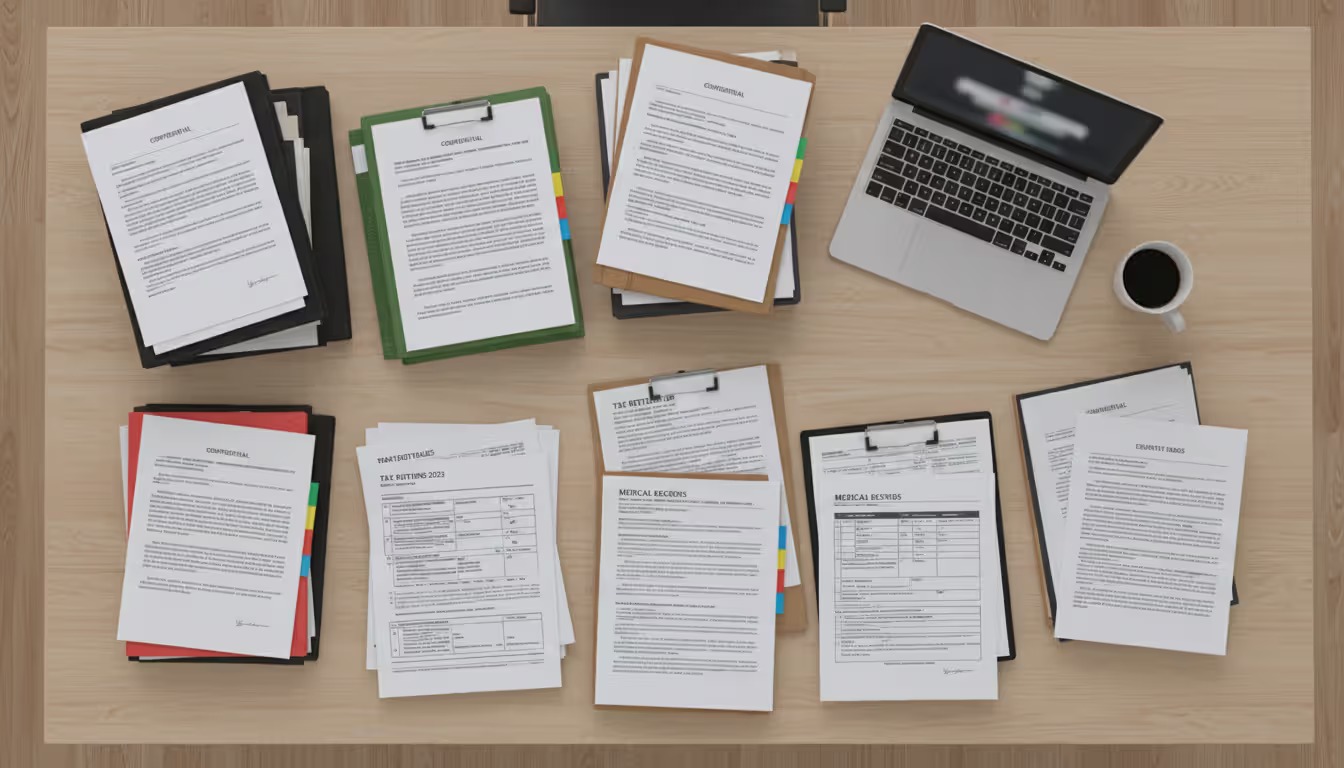
Courts want comprehensive financial evidence covering past, present, and future. You can't just testify that you're broke and hope for the best. Successful discharge cases typically involve several hundred pages of exhibits.
Income documentation: Plan to provide at least three years of tax returns, recent pay stubs covering several months, proof of any government benefits (Social Security, disability, unemployment, food stamps), and your spouse's income if you're married. If your income decreased, you'll need to explain why with supporting documentation.
Detailed expense records: Create an itemized monthly budget listing every expense category. Provide supporting documentation—lease or mortgage statement, utility bills for at least three months, car payment records, insurance bills, prescription costs, medical bills. Courts compare your expenses to local and national standards, so be prepared to justify anything above those benchmarks.
Medical evidence (if applicable): When health problems contribute to hardship, you'll need complete medical records from all treating physicians, written statements from doctors explaining your limitations and prognosis, documentation of ongoing treatment costs, and sometimes independent medical examinations. Generic statements won't suffice—courts want specific detail about how your conditions limit your ability to work and why improvement is unlikely.
Employment and career documentation: Your complete work history including positions held, dates, and earnings. If you're claiming limited job prospects, bring proof of applications you've submitted, rejection letters, evidence of completed job training or retraining attempts, and possibly vocational expert testimony explaining why your skillset has limited market value.
Educational records: Transcripts and degrees from all institutions you attended. Paradoxically, strong academic performance might hurt you by suggesting you have marketable skills, while poor performance could support hardship if it indicates learning disabilities or other limitations.
Loan payment history: Complete records from your servicers showing every payment you made (or didn't make), proof that you applied for income-driven repayment plans or deferments when appropriate, correspondence with servicers attempting to manage your debt, and evidence of any rehabilitation or consolidation efforts.
Many successful cases include expert witness testimony. A vocational rehabilitation counselor might testify that someone with your age, health, education, and work history has minimal earning capacity. A financial economist might project your future earnings and expenses, demonstrating mathematical impossibility of repayment. These experts charge $3,000 to $8,000 or more, but their testimony can make the difference between winning and losing.
Chapter 7 vs. Chapter 13 for Student Loan Discharge
You can attempt student loan discharge in either Chapter 7 or Chapter 13 bankruptcy, though the procedural context differs.
Feature
Chapter 7
Chapter 13
Court filing fee
$338
$313
How long the base case lasts
4-6 months typically
3-5 years of payments
Do you still need the adversary proceeding
Absolutely—there's no way around it
Yes—you must file it separately
Likelihood of discharge approval
Difficult to obtain but possible
Just as difficult as Chapter 7
Income restrictions
You must pass the means test
Need reliable income for plan payments
What happens to your assets
Non-exempt property gets sold
You keep assets but pay based on their value
Who this works best for
Low earners with few valuable assets
People with regular paychecks and property to protect
Chapter 7 liquidates your non-exempt assets (though most people have little that's non-exempt), distributes proceeds to creditors, and wipes out qualifying debts. The base bankruptcy case wraps up quickly—usually four to six months from filing to discharge. Your student loan adversary proceeding runs on its own much longer timeline.
Chapter 7 makes sense for people with minimal income and few assets. If you're earning poverty-level wages, have no home equity or valuable property, and can demonstrate you literally cannot afford basic living expenses while servicing loans, Chapter 7 provides the quickest route to potential relief.
Chapter 13 creates a court-supervised repayment plan lasting three to five years. You funnel your disposable income to a trustee who distributes it to creditors according to priority rules. Student loans are low-priority unsecured debt, so they often receive little or nothing during your plan.
Here's a strategic consideration: you can file your adversary proceeding during your Chapter 13 plan or after completing it. Some attorneys suggest waiting until the end gives you a stronger case—you'll have three to five years of documented minimal income and good faith payment attempts. However, waiting also means delaying relief and remaining in bankruptcy purgatory for years.
Chapter 13 works better if you're employed with regular income, own property you need to protect (like a home facing foreclosure), or have debts that benefit from Chapter 13's other features (like curing a mortgage default or cramming down a car loan).
Does filing for bankruptcy eliminate student loan debt differently under one chapter versus the other? Not really. Both require the adversary proceeding, both apply the same hardship standard, and both lead to roughly similar approval rates. Your choice between chapters should depend primarily on your overall financial situation—your income, assets, other debts, and circumstances—not specifically on student loan discharge considerations.
Discharge approval rates remain difficult to quantify precisely. A frequently-cited study by Harvard professor Rafael Pardo found that fewer than 0.1% of bankruptcy filers even attempted student loan discharge in the time period he studied, and among those brave souls, somewhere between 20% and 40% achieved full or partial discharge depending on the jurisdiction. More recent anecdotal reports from bankruptcy attorneys suggest success rates may have improved modestly since the 2022 policy changes, perhaps reaching 30-50% in cases that actually go to trial, but hard data remains scarce.
Private Student Loans vs. Federal Student Loans in Bankruptcy
The undue hardship requirement technically applies to both federal and private educational debt, but these loan types face different practical challenges in bankruptcy.
Federal student loans come with unique repayment flexibility that paradoxically makes discharge harder to obtain. The government offers income-driven repayment plans that cap payments at 10-20% of discretionary income—potentially $0 monthly if you're earning poverty wages. Courts frequently reason that if you can make $0 payments through an income-driven plan, how can loan repayment constitute undue hardship?
Author: Ethan Calloway;
Source: dynamicrangemetering.com
This creates a catch-22. The government argues: "You don't need discharge because we offer affordable repayment options!" But those "affordable" plans extend repayment to 20 or 25 years, during which interest compounds, and eventual forgiveness creates potential tax liability. Plus, the forgiveness promise depends on future political decisions—Congress could eliminate these programs tomorrow.
The 2022 Justice Department guidance changed the federal government's approach significantly. DOJ attorneys now evaluate cases using specific factors: borrower age (retirement age or close to it helps), disability or chronic health conditions, minimal income with no prospect of increase, substantial time since loans were borrowed, educational credentials that haven't produced corresponding income, and payment history showing good faith.
When borrowers clearly meet multiple factors, the government may consent to discharge rather than fighting. This doesn't guarantee your loans disappear—the judge still needs to approve—but removes the government's opposition, which historically killed most cases.
Private student loans operate under completely different rules. Most private lenders don't offer income-driven repayment. You'll get perhaps six to twelve months of forbearance over your loan's lifetime, then you pay the monthly minimum or default. Period.
Some courts have recognized that this inflexibility strengthens hardship arguments. When the only options are "pay the full monthly amount" or "default and get sued," borrowers genuinely may face impossible choices. Federal loans don't force that binary decision.
More interestingly, recent cases have successfully eliminated some private loans on technical grounds without proving hardship at all. The key is whether the loan qualifies as an "educational loan" under bankruptcy law's definition. That statute protects loans for "qualified higher education expenses" at "eligible educational institutions."
The Homaidan v. Sallie Mae case from 2012 (Eastern District of New York) determined that certain private loans didn't qualify for bankruptcy protection because they funded expenses beyond the statute's definition. Other courts have discharged private loans funding for-profit programs that lost accreditation, bar review courses, or living expenses that exceeded the school's cost of attendance budget.
This creates a potential discharge pathway for some private loans: argue the loan doesn't meet statutory requirements for bankruptcy protection, and if successful, it can be discharged as regular unsecured debt without proving hardship. This won't work for most loans—the typical private student loan funding tuition at an accredited college clearly qualifies for protection—but it's worth investigating if your loan funded something non-traditional.
Federal loans rarely offer this technical escape hatch. Direct Loans from the Department of Education almost always meet the statutory definition, leaving hardship proof as your only pathway.
Alternatives to Bankruptcy for Student Loan Relief
Before you spend $10,000 on an adversary proceeding with uncertain outcome, exhaust every other possibility.
Income-driven repayment plans restructure federal loans so monthly payments equal 10-20% of your discretionary income. The SAVE plan (fully implemented in 2024) calculates payments at 10% of income above 225% of the federal poverty line—far more generous than earlier IDR plans. Single person earning $35,000 annually? Your monthly payment might be $88. Earning $25,000? Your payment could be $0.
After 20 years of payments (10 years for borrowers who only took undergraduate loans under SAVE), the government forgives the remaining balance. Yes, you're making payments for two decades. But $0 to $100 monthly beats bankruptcy litigation that might fail anyway.
Public Service Loan Forgiveness erases federal loans after 120 qualifying monthly payments (ten years) while working for government or qualifying nonprofits. Teachers, nurses, public defenders, social workers, librarians at public libraries, employees of 501(c)(3) organizations—millions of workers qualify.
PSLF underwent major improvements in 2021-2022 after years of dysfunction and denials. The program now works relatively well if you follow the rules: submit annual employment certification forms, ensure you're in a qualifying repayment plan, stay employed at qualifying organizations. Forgiveness is tax-free forever, thanks to 2021 legislation.
If you already work in public service, PSLF likely provides faster relief than bankruptcy ever could. Why spend $8,000 litigating discharge over eighteen months when you're three years from PSLF forgiveness anyway?
Total and Permanent Disability discharge eliminates federal loans for borrowers who become disabled. You'll need certification from a doctor, the Social Security Administration, or the Department of Veterans Affairs, depending on which discharge pathway you use. The application takes months, not years, and requires no court appearance.
Congress eliminated the tax penalty for disability discharge in 2017, and made that tax relief permanent in 2021. Previously, discharged loan balances were treated as taxable income—sometimes creating five-figure tax bills for people already living on disability benefits. That nightmare scenario is gone.
Settlement negotiations occasionally succeed with private loans, particularly if you're already in default. Private lenders sometimes accept lump-sum settlements for 40-60% of the outstanding balance. This requires access to cash—maybe a family member could lend you the settlement amount—but avoids both bankruptcy and continued debt.
Federal loans rarely settle for less than the full balance. The government's position is that they already offer generous repayment terms, so they won't negotiate principal reductions. Private lenders, facing potential discharge in bankruptcy or complete loss if you never recover financially, may be more flexible.
Loan rehabilitation cures defaulted loans and restores access to income-driven plans and deferment. If you defaulted years ago and your loans are with a collection agency, rehabilitation might reopen options you didn't know existed.
When does bankruptcy make sense given these alternatives? Consider it when you're earning too much for $0 IDR payments but far too little to realistically repay your loans in your lifetime, when you don't qualify for PSLF or disability discharge, when you're filing bankruptcy for other debts anyway (making the adversary proceeding an add-on expense rather than standalone cost), or when you're approaching retirement age with six-figure student loan debt and Social Security garnishment looming.
Bankruptcy pursued exclusively for student loans rarely makes financial sense. The cost-benefit analysis doesn't work—spend $8,000 to $15,000 for maybe a 30% chance of success? But if you're filing bankruptcy anyway to eliminate $40,000 in credit card debt and $20,000 in medical bills, adding the adversary proceeding for your $80,000 in student loans might be worthwhile.
Common Mistakes When Trying to Discharge Student Loans
Borrowers pursuing discharge frequently sabotage their own cases through avoidable errors.
Author: Ethan Calloway;
Source: dynamicrangemetering.com
Finishing bankruptcy without filing the adversary proceeding. This happens constantly. People file Chapter 7, attend their meeting of creditors, receive their discharge, then discover their student loans survived intact. They spent $2,000 on bankruptcy attorney fees and accomplished nothing for their primary financial problem. I've watched this happen to three different friends who ignored their lawyers' warnings that student loans required additional action.
Showing up to trial with minimal evidence. One case I read about involved a debtor who appeared with six pay stubs and his own testimony about struggling financially. No detailed budget. No expert witnesses. No medical evidence despite claiming health problems. The judge spent maybe twenty minutes denying his petition. Courts demand comprehensive evidence—hundreds of pages of financial documentation and multiple witnesses.
Failing to establish payment history showing good faith. Making zero payments for five years despite steady employment destroys the third Brunner prong instantly. Even if you couldn't afford the standard monthly payment, courts expect you to have made some payments, applied for income-driven repayment, or at least requested forbearance during unemployment rather than ignoring the debt completely.
Procedural timing mistakes that complicate everything. In Chapter 7 cases, you should file your adversary proceeding before the court enters your main discharge order. Filing after discharge requires reopening your bankruptcy case—possible but annoying and sometimes costly. In Chapter 13, timing is more flexible, but waiting until after plan completion adds procedural steps.
Failing to request partial discharge as an alternative. Maybe the court won't eliminate all $120,000 of your debt, but might discharge $80,000 as causing undue hardship while leaving $40,000 enforceable. If you demand all-or-nothing, some judges will give you nothing. Requesting partial relief provides flexibility and might salvage meaningful benefit from your case.
Presenting an inflated expense budget that destroys credibility. Claiming you need $900 monthly for groceries as a single person, or including $400 for entertainment as a necessary expense, won't survive scrutiny. Judges compare budgets to IRS standards and common sense. When they catch obvious padding, they assume your entire case lacks credibility.
Filing Chapter 7 when you don't satisfy the means test. If your income exceeds the median for your state and you can't pass the means test showing insufficient disposable income, your entire Chapter 7 case might be dismissed or converted to Chapter 13. You'll never reach the adversary proceeding because your underlying bankruptcy fails first.
Attempting this without an attorney experienced in student loan discharge. Even experienced bankruptcy attorneys often lack expertise in the specific subspecialty of student loan adversary proceedings. You need someone who's handled these cases before and won at least some of them. Self-representation in this context virtually guarantees failure—I've never seen a pro se debtor successfully discharge student loans, and I've read perhaps fifty reported cases.
Frequently Asked Questions
Does filing bankruptcy automatically wipe out student loans?
No—absolutely not. Filing Chapter 7 or Chapter 13 bankruptcy accomplishes exactly nothing for your student loans unless you also file a separate adversary proceeding and prove undue hardship. I've known people who completed their entire bankruptcy, celebrated their discharge, then got collection calls two months later because they never took this additional required step. Your educational debt remains 100% enforceable after regular bankruptcy unless you win this separate legal action.
What becomes of my educational debt if I skip filing the adversary proceeding?
Your loans persist exactly as they existed before bankruptcy—identical balance, same interest rate, unchanged payment terms. Once your bankruptcy discharge eliminates your other debts, your loan servicer will restart collection efforts on your student debt. Federal loans in default status before you filed can resume wage garnishment and tax refund offsets as soon as your bankruptcy closes.
What's the price tag for filing an adversary proceeding targeting student loans?
Courts charge a $350 filing fee on top of whatever you already paid for your base bankruptcy case. Attorney fees typically run $3,000 to $10,000 depending on case complexity and whether you reach trial or settle earlier. Expert witnesses—vocational counselors, medical professionals, financial economists—add another $3,000 to $8,000 total. All-in costs frequently hit $8,000 to $15,000 for contested proceedings that go to trial. Some legal aid organizations and law school bankruptcy clinics handle these cases for low-income clients at reduced or no cost, but capacity is extremely limited.
Is it possible to eliminate only a portion of my student loan debt through bankruptcy?
Absolutely—courts have authority to grant partial discharge, wiping out some of your balance while leaving the rest enforceable. This might happen when you prove hardship for certain specific loans but not others, or when a judge concludes that eliminating everything seems excessive but some relief appears justified. Partial discharge has become increasingly common since 2022 as judges apply hardship standards more flexibly. I've seen cases where borrowers got 60-70% of their balances discharged while keeping the remainder, which still provides massive financial relief.
How does bankruptcy impact my eligibility for future student loans?
Bankruptcy filing doesn't automatically disqualify you from federal student aid programs going forward. You can still receive federal student loans, Pell Grants, and other Department of Education assistance after bankruptcy. However, you cannot be in default status on existing federal loans, and you must still satisfy standard eligibility requirements like satisfactory academic progress. Private student loans may prove tougher to secure since bankruptcy tanks your credit score for several years, though federal student loans don't involve credit checks for most undergraduate programs anyway.
How much time does the entire student loan discharge process consume?
The base Chapter 7 bankruptcy runs four to six months typically. Chapter 13 extends three to five years. Your adversary proceeding operates on its own schedule independent of those timelines, usually requiring eight months to two years from filing your complaint until final judgment if the case is contested. Settlement discussions might resolve matters in four to six months. If either party appeals the judge's decision, add another twelve to twenty-four months. Total elapsed time from the day you file bankruptcy until you receive a final determination on your student loans often exceeds eighteen to thirty months in contested cases that reach trial.
Discharging student loans through bankruptcy remains one of the most challenging debt relief options in American law. The undue hardship standard creates barriers that most borrowers simply cannot overcome, requiring proof of financial catastrophe that courts traditionally interpret with extreme strictness.
Recent developments have created modest improvements. The Justice Department's 2022 policy shift means the government no longer contests every discharge request reflexively. Some bankruptcy judges have begun applying hardship standards more reasonably or granting partial discharge when total elimination seems unwarranted. Legislative proposals circulating in Congress might eventually codify a more accessible discharge standard, though nothing has passed as of 2026.
Despite these encouraging signs, discharge continues representing the exception in bankruptcy practice. You'll need overwhelming evidence of genuine, permanent financial dysfunction. Comprehensive documentation covering every aspect of your financial life. Expert witness testimony costing thousands. Legal representation from an attorney who's actually won these cases before. And patience for litigation extending eighteen months to three years.
Before pursuing bankruptcy for student loans, exhaust every alternative. Income-driven repayment plans offer $0 to $100 monthly payments for low earners with eventual forgiveness. PSLF provides tax-free forgiveness after ten years for public service workers. Disability discharge eliminates loans for qualifying borrowers without litigation. These programs deliver relief without the expense and uncertainty of adversary proceedings.
Bankruptcy makes most sense when you're already filing to eliminate other debts and meet the hardship standard clearly, when you're approaching retirement age with six-figure educational debt and no realistic repayment pathway, or when your income exceeds the $0-payment IDR threshold but remains too low to retire your debt in your remaining working years.
If you decide to proceed, understand that filing bankruptcy accomplishes nothing for student loans without the adversary proceeding. You must file this separate action. You must compile extensive financial documentation. You must prove your hardship will persist for years. And you absolutely must retain experienced legal counsel—student loan discharge demands professional expertise you cannot replicate through internet research.
The student loan bankruptcy landscape continues evolving. Court decisions, government policies, and potential legislation may eventually make discharge more accessible. For now, approach this option with realistic expectations, thorough preparation, and qualified legal guidance. Success is possible, but only for those who truly meet stringent hardship standards and navigate the complex process correctly.
Medical bankruptcy helps thousands of Americans eliminate overwhelming healthcare debt each year. This guide explains how bankruptcy discharges hospital bills, which chapter to file, the complete process, costs, and consequences of using bankruptcy to clear medical debt permanently
Bankruptcy stays on credit reports for 7-10 years, but errors happen frequently. Discover how to identify bankruptcy reporting mistakes, dispute inaccurate information with credit bureaus, and rebuild your credit score through proven strategies after bankruptcy discharge
Bankruptcy remains on your credit report for 7-10 years depending on the chapter filed, but its impact diminishes significantly over time. Understanding the specific timeline and taking strategic rebuilding steps helps you recover your credit score and qualify for loans years before the bankruptcy notation disappears
Filing for bankruptcy triggers significant credit consequences, but understanding the specific impact helps you prepare and recover. Chapter 7 stays on your report for 10 years and can drop scores 150-240 points, while Chapter 13 remains for 7 years with a 130-200 point decrease
The content on this website is provided for general informational and educational purposes only. It is intended to explain concepts related to bankruptcy, debt relief, credit rebuilding, and related legal processes.
All information on this website, including articles, guides, and examples, is presented for general educational purposes. Bankruptcy outcomes and procedures may vary depending on jurisdiction, personal circumstances, and applicable laws.
This website does not provide legal, financial, or credit advice, and the information presented should not be used as a substitute for consultation with qualified attorneys or financial advisors.
The website and its authors are not responsible for any errors or omissions, or for any outcomes resulting from decisions made based on the information provided on this website.