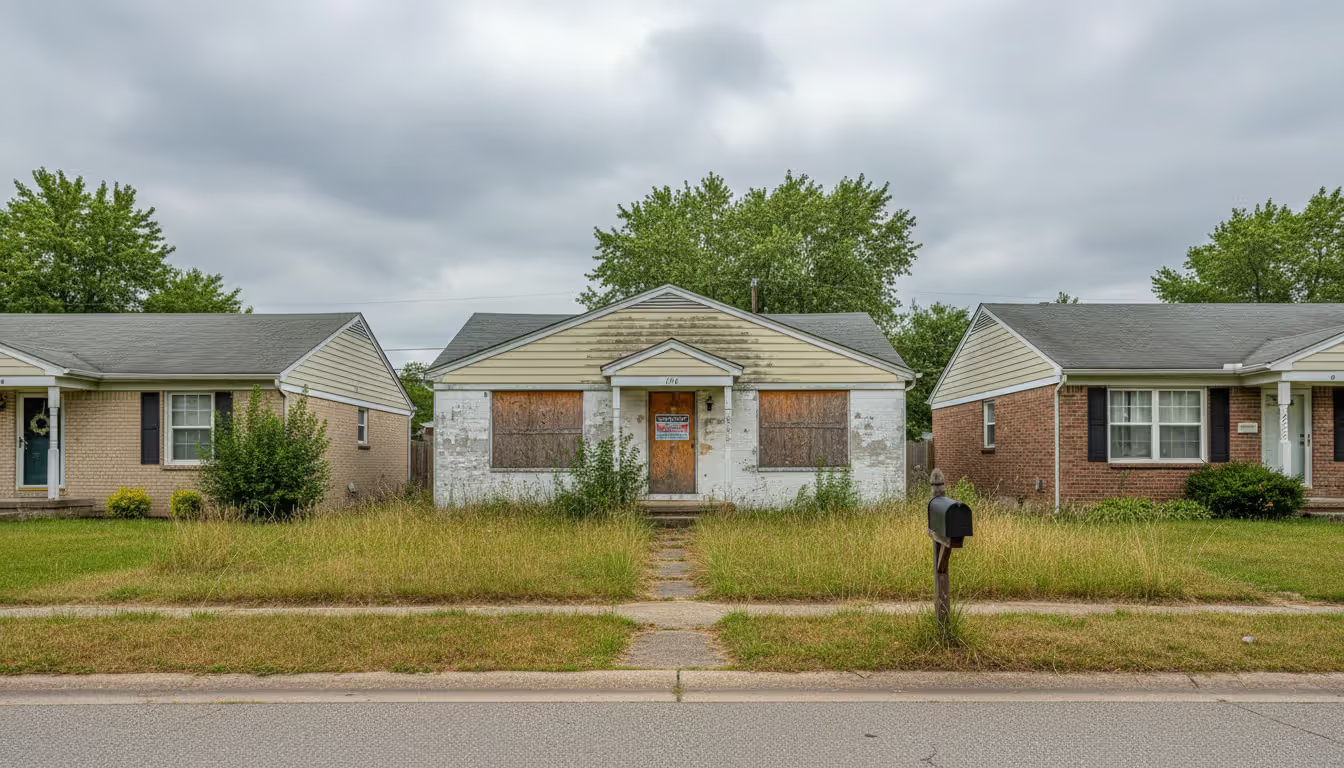
Can't keep up with your house payment anymore? You're probably scared—maybe even losing sleep over it. Job disappeared? Medical bills piling up? Divorce draining your bank account? Whatever landed you here, you're likely wondering: “Is there any way out of this mortgage that won't destroy me financially or land me in legal trouble?”
Here's what most people don't realize: missing your mortgage payment won't put you behind bars. This isn't a criminal situation. You're dealing with contract law, not the police. The consequences hit your wallet and credit report—not your freedom.
You've got several legitimate paths forward in 2026: bankruptcy filings, negotiated exits with your lender, or walking away strategically. Each one comes with its own timeline, hits your credit differently, and costs you different amounts. Let's break down exactly what works, when it works, and what it'll cost you.
Understanding Your Legal Rights When You Can't Pay Your Mortgage
Your mortgage is a contract—you borrowed money, your house secures that loan. Stop paying? Your lender gets to foreclose. That's the deal you signed. But here's what they don't tell you: defaulting on that agreement doesn't make you a criminal. It doesn't equal fraud. You're not stealing. You're breaking a contract, which happens in civil court, not criminal court.
Nobody's coming to arrest you.
Federal and state regulations actually protect homeowners more than most people know. Take the automatic stay in bankruptcy—it slams the brakes on foreclosure the moment you file, even if the sale's scheduled for tomorrow. The Homeowner Assistance Fund? Still operating in many states through 2026, offering grants to qualified borrowers. And state laws vary wildly on whether lenders can chase you for the shortfall after foreclosure. California, Arizona, Alaska—they limit that significantly for primary residence purchase loans.
But here's the thing about stopping payments "legally"—it means using the system, not ignoring it. You can't just stop paying and disappear, hoping it works out. That leaves you exposed to foreclosure, potential lawsuits for what you still owe, and tax bills on forgiven debt you could've avoided.
People come into my office believing they're completely stuck. They're not. Federal bankruptcy codes exist specifically to handle mortgage debt you can't pay. What matters is picking the right tool for what you're trying to accomplish—whether you want that debt erased completely, your payments restructured to something manageable, or a clean exit from homeownership without getting sued for the difference
— Jennifer Martinez
When does stopping payments make sense? After you've genuinely tried other options. After you've looked at loan modifications and realized they won't work. When you've got a specific plan for dealing with the debt—not just crossing your fingers.
When's it risky? When you act impulsively. When you don't know your state's foreclosure laws (some states take 60 days, others drag out 18 months). When you ignore the tax angle entirely.
Biggest mistakes I see: stopping payments before talking to an attorney, not documenting why you can't pay anymore, failing to explore every program simultaneously. Some people qualify for assistance they never even applied for because they didn't know it existed.
Bankruptcy Options for Mortgage Relief
Bankruptcy gives you the most powerful legal framework available for dealing with mortgage debt. Two chapters matter for most homeowners: Chapter 7 and Chapter 13. They work completely differently and suit different situations.
Author: Ethan Calloway;
Source: dynamicrangemetering.com
Chapter 7 Bankruptcy and Mortgage Surrender
Chapter 7—people call it liquidation bankruptcy—wipes out most unsecured debts in three to four months. Want to walk away from your house and never owe another dime on it? Chapter 7 delivers that.
Filing triggers an automatic stay immediately. Foreclosure stops, even if the auction's tomorrow. Then you've got three choices: surrender the place, reaffirm the debt (agree you'll still owe it despite bankruptcy), or redeem it (pay what it's worth now in one lump sum). Most people surrendering their home pick option one.
Surrendering works like this: you mark on your bankruptcy paperwork that you're giving up the house. That mortgage debt gets discharged—you're not personally liable anymore. Doesn't matter if the bank sells it for $100,000 less than you owed. They can't touch you for that difference. The lender will eventually foreclose and sell, but you're bulletproof against collection efforts on that loan.
Your credit takes a serious hit—Chapter 7 sticks around for ten years from filing day. But think about it: if you're already four months behind on your mortgage, how much worse can it get? Many people watch their scores start climbing again within 12-18 months because those old late payments age off and they're building new positive history.
From filing to discharge usually takes 90-120 days. You'll typically stay in the house during that period. Depending on your state's foreclosure speed, you might live there several months longer—some people get six months or more rent-free while the foreclosure grinds through.
Chapter 13 Bankruptcy and Restructured Payments
Chapter 13 takes a different approach—you're setting up a repayment plan for three to five years based on your income. This works for homeowners who want to keep their house and earn regular paychecks to support a plan.
With Chapter 13, you catch up on what you're behind over the plan's life while making your current payments. Behind $15,000? Maybe you pay $250 monthly toward that while also making your regular $1,800 mortgage payment. Foreclosure stops. You get breathing room to recover.
You could surrender in Chapter 13 too, though that's unusual since Chapter 7 does the same thing faster. But maybe Chapter 13 makes sense because you've got other debts to restructure or you earn too much to qualify for Chapter 7.
Chapter 13 offers something unique for second mortgages: if your home's value fell below your first mortgage balance, you can sometimes "strip off" that second mortgage entirely. It becomes unsecured debt that might get discharged for pennies on the dollar after your plan completes.
Credit impact's slightly gentler—Chapter 13 appears for seven years versus ten for Chapter 7. But you're committing to a multi-year payment plan. Fail to finish it? Case gets dismissed, debts come back.
Foreclosure Alternatives That Stop Mortgage Payments
Several options let you stop paying through deals with your lender instead of bankruptcy. These usually hurt your credit less than bankruptcy, though they don't wipe out your other debts.
Deed in Lieu of Foreclosure
With a deed in lieu, you hand over your house title to the lender voluntarily. They release you from the mortgage in exchange. You're basically returning the keys and walking away.
Lenders like this better than foreclosure—it's faster and cheaper for them. Takes 60-90 days typically, versus six months or longer for foreclosure. You avoid the public foreclosure record. Many lenders sweeten the deal with "cash for keys"—relocation money ranging from $2,000 to $10,000.
But lenders get picky about accepting these. Your property needs to have been listed for sale unsuccessfully—usually 90 days minimum. You can't have other liens—tax liens or second mortgages complicate everything. They'll want financial documents proving you genuinely can't make payments.
Your credit score drops 125-160 points, stays on your report seven years. Still better than foreclosure or bankruptcy. The critical part? Negotiate that the lender won't sue you for any shortfall. Get that commitment in writing before you sign a single page.
Main advantage over bankruptcy: deed in lieu only touches your mortgage. Your other debts stay separate. You avoid bankruptcy's broader financial exposure and public filing.
Short Sale Options
Short sales mean selling your property for less than your loan balance, with your lender agreeing to accept the proceeds. This works when you can't afford payments but your home's value sits close to what you owe.
You need lender approval before even listing. They'll want hardship documentation and financial records. Once approved, you list at market value (even though that's below your mortgage balance). When someone makes an offer, your lender must approve that sale price too.
Timeline's all over the map—three to nine months is normal, though some stretch past a year. During this time, you typically don't make mortgage payments. You're living in the house while it's being marketed.
Watch out for deficiency judgments. In recourse states, lenders can sue you for the gap between sale price and what you owed. Always negotiate deficiency waiver into the short sale agreement. Some states prohibit deficiency judgments on short sales, but don't assume anything—check your specific state law.
Credit score drops 125-160 points, seven years on your report. Similar to deed in lieu. Sometimes future lenders view short sales more favorably than foreclosures, though.
Walking Away: Strategic Default Explained
Strategic default means deliberately stopping payments when you're underwater (owing more than the home's value) even though you could technically still pay. This got common after 2008's housing crash. Still legal, though ethically controversial.
The legal piece hinges on recourse versus non-recourse loans. Non-recourse loans—common in Alaska, Arizona, California, and a few other states for purchase-money mortgages—prevent lenders from suing you for deficiencies. You walk away owing nothing beyond losing the property.
Recourse loans let lenders sue for shortfalls. In those states, strategic default without bankruptcy protection is dangerous—you might face a judgment that haunts you for years.
Consequences include brutal credit damage (similar to foreclosure), possible tax liability on forgiven debt, and rental difficulties (landlords check credit thoroughly). Some states have extended foreclosure timelines—you might live payment-free for 12-18 months—but you'll deal with uncertainty and stress the whole time.
Strategic default only makes sense in narrow situations: serious negative equity, non-recourse loan, strong income to rebuild credit fast, and comfort with the ethical questions.
Author: Ethan Calloway;
Source: dynamicrangemetering.com
Home Loan Modification vs. Bankruptcy: Which Path Is Right?
Loan modification and bankruptcy accomplish different things, though both can provide mortgage relief. Knowing when each makes sense saves you costly mistakes.
Modifications permanently change your mortgage terms—lower interest rate, longer term, occasionally principal reduction (rare). They work best when you've got steady income but your current payment's unaffordable because of the interest rate, temporary hardship you've now recovered from, or original loan terms you simply can't sustain long-term.
Qualifying requires proving hardship plus sufficient income for modified payments. Most modifications require you to be behind first—creating a frustrating catch-22 where you damage your credit before you can even apply. The process drags three to six months with no guarantee of approval.
Bankruptcy makes more sense when modifications aren't offered or don't reduce payments enough, when you're carrying substantial other debts to discharge, or when you want to surrender the property without getting sued for the difference. Bankruptcy provides certainty—you know the outcome within months. Modification applications can stretch indefinitely with multiple rejections.
Cost comparison: modifications typically cost nothing working directly with your lender, or $2,000-$4,000 hiring a modification company (often unnecessary and sometimes scams). Chapter 7 bankruptcy runs $1,500-$3,000 in attorney fees plus $338 filing fee. Chapter 13 costs $3,000-$5,000 in attorney fees plus $313 filing fee.
Credit-wise, modifications win—they show as "paying under partial payment agreement" rather than bankruptcy or foreclosure. But if you're already delinquent when applying, the damage already happened.
Option
Timeline
Credit Score Impact
Debt Discharged?
Keep Home?
Estimated Costs
Chapter 7 Bankruptcy
3-4 months
-200 to -250 points; remains 10 years
Yes, all qualifying unsecured debt plus mortgage deficiency
No (when surrendering)
$1,800-$3,300 total
Chapter 13 Bankruptcy
3-5 years
-150 to -200 points; remains 7 years
Partial; determined by plan
Yes (if maintaining current payments)
$3,300-$5,300 total
Deed in Lieu
2-3 months
-125 to -160 points; remains 7 years
Mortgage only (if properly negotiated)
No
Minimal to none
Loan Modification
3-6 months
-40 to -80 points (if delinquent before applying)
No
Yes
$0-$4,000
Short Sale
3-9 months
-125 to -160 points; remains 7 years
Mortgage only (if deficiency waived)
No
Real estate commissions
Strategic Default
6-18 months
-200 to -250 points; remains 7 years
No (except non-recourse loans)
No
Potential deficiency judgment risk
What Happens to Your Mortgage in Chapter 7 Bankruptcy
Chapter 7 doesn't automatically erase your mortgage—it's secured debt, meaning the lender's property claim survives bankruptcy. What it does eliminate is your personal liability for that debt, which is exactly what lets you stop paying legally.
Filing immediately triggers the automatic stay, halting all collection activity. Foreclosure sales scheduled for tomorrow get canceled. You've got breathing room to decide your next move.
Four options exist for handling your mortgage in Chapter 7:
Surrender is what most people seeking to stop payments choose. Mark on your bankruptcy schedules that you're giving up the property. Discharge eliminates your personal liability—even if the house sells for less than you owed, you won't owe the difference. The lender will eventually foreclose, but you're protected from collection.
Reaffirmation means signing paperwork to remain personally liable despite bankruptcy. Only makes sense if you're keeping the home and want the lender reporting your payments to credit bureaus. But you lose discharge protection—default later and you'll owe the deficiency.
Redemption lets you keep the property by paying its current fair market value as a lump sum, even if that's less than you owe. Rarely practical—few people filing bankruptcy have cash for lump-sum payments—but it exists.
Ride-through (in some jurisdictions) means continuing payments without reaffirming. You keep the home as long as you pay, but defaulting later means no deficiency because the debt was discharged. Not all courts recognize ride-through—check local practice.
Deficiency judgments can't be pursued after Chapter 7 discharge, regardless of your state's foreclosure rules. This is bankruptcy's most powerful protection for underwater homeowners.
Step-by-Step: The Bankruptcy Mortgage Surrender Process
Understanding the surrender process helps you plan timing and avoid surprises.
Step 1: Pre-filing preparation (2-4 weeks before filing) Collect financial documents: recent pay stubs, last two years' tax returns, bank statements, complete list of debts and assets. Complete required credit counseling (available online, runs about $50). Consult a bankruptcy attorney to verify Chapter 7 eligibility and discuss your specific circumstances.
Step 2: Filing the petition (Day 1) Your attorney files the bankruptcy petition along with schedules and financial affairs statement at the court. You pay the $338 filing fee (or request fee waiver if qualified). Automatic stay activates immediately at filing, stopping all collection activity.
Step 3: Indicate surrender on schedules Schedule A/B lists the property and its current value. Schedule D lists the mortgage debt. Critically, the Statement of Intention (filed within 30 days of petition) indicates you're surrendering the property.
Step 4: Meeting of creditors (3-5 weeks after filing) You attend a brief meeting (usually 10-15 minutes) where the trustee questions you about your finances under oath. Mortgage lenders almost never show up. You'll need photo identification and Social Security proof.
Step 5: Trustee administration (30-60 days after filing) The trustee determines whether you have non-exempt assets worth liquidating. Most filers have none—homestead exemptions and other exemptions protect basic possessions. Since you're surrendering the home, this isn't an issue.
Step 6: Discharge (90-120 days after filing) The court issues your discharge order, eliminating personal liability for the mortgage and other discharged debts. You receive a discharge certificate.
Step 7: Foreclosure and vacating (varies widely) After discharge, the lender proceeds with foreclosure under state law. This ranges from 60 days to 18 months depending on your state and the lender's backlog. You're not legally required to leave until foreclosure completes and the property sells. Many homeowners live payment-free during this entire period.
Documentation you'll need: Last six months of pay stubs, two years of tax returns, statements for all bank accounts, current mortgage statement, property tax records, homeowner's insurance policy declarations, itemized list of personal property with estimated values, documentation explaining any unusual expenses or income fluctuations.
Tax implications matter significantly. Forgiven mortgage debt might count as taxable income under IRS rules. But the Mortgage Forgiveness Debt Relief Act, extended through 2025 and probably getting renewed, excludes forgiven mortgage debt on principal residences up to $750,000 from taxable income. Plus, debt discharged in bankruptcy is never taxable. Consult a tax professional—rules change and exceptions get complicated fast.
Author: Ethan Calloway;
Source: dynamicrangemetering.com
Frequently Asked Questions
Can I stop paying my mortgage without going to jail?
Absolutely. Mortgage default is civil, not criminal. You can't be arrested or jailed for failing to pay your mortgage. The lender's remedies are all civil: foreclosure, possibly suing for deficiency (in some states), and reporting to credit bureaus. However, mortgage fraud—lying on your application or deceiving the lender intentionally—is criminal. Simply being unable to afford payments isn't fraud.
What is the difference between Chapter 7 and Chapter 13 for mortgage debt?
Chapter 7 eliminates your personal liability for the mortgage within 3-4 months, letting you surrender the home without owing any deficiency. Best for people wanting to exit the property quickly. Chapter 13 establishes a 3-5 year repayment plan, letting you catch up on what you're behind while keeping the home. Best for people with regular income who want to save their home. Chapter 7 appears on your credit report for 10 years; Chapter 13 for 7 years.
Will I owe money after surrendering my home in bankruptcy?
No. Surrendering your home in bankruptcy and receiving a discharge eliminates your personal liability for the mortgage debt. Even if the home sells for less than you owed—suppose you owed $300,000 but it sold for $200,000—you won't owe that $100,000 deficiency. This applies regardless of whether your state normally allows deficiency judgments after foreclosure. Bankruptcy discharge overrides state foreclosure law.
How long does deed in lieu of foreclosure take compared to bankruptcy?
Deed in lieu typically requires 60-90 days from initial application to closing, though slow lenders can push it to 120 days. Chapter 7 bankruptcy takes 90-120 days from filing to discharge. However, bankruptcy also discharges your other unsecured debts. Total timeline from stopping payments to moving out is similar for both, though deed in lieu may require you to vacate sooner since you're directly transferring title to the lender.
Can I buy another home after using bankruptcy for mortgage relief?
Yes, though waiting periods apply. Conventional loans typically require 4 years after Chapter 7 discharge or 2 years after Chapter 13 discharge (if you completed the plan successfully). FHA loans have shorter waits: 2 years after Chapter 7 or 1 year after Chapter 13 (with court approval and solid payment history). VA loans require 2 years after Chapter 7. These are general guidelines—lenders may impose longer waiting periods, and you'll need to rebuild your credit score to qualify for decent rates. Many bankruptcy filers qualify for mortgages within 2-3 years by maintaining perfect payment history on remaining debts.
What are the tax consequences of walking away from my mortgage?
Forgiven mortgage debt might count as taxable income per IRS rules. If your lender forgives $100,000 of debt (the difference between what you owed and what the home sold for), you might receive a 1099-C reporting that as income. Several exceptions apply though. The Mortgage Forgiveness Debt Relief Act excludes forgiven debt on principal residences up to $750,000 (extended through 2025, likely getting renewed). Debt discharged in bankruptcy is never taxable. The insolvency exception applies if your total debts exceeded your total assets when the debt was forgiven. Consult a tax professional to determine which exceptions apply—the rules get complex and depend heavily on your specific facts.
Legally stopping mortgage payments requires understanding your options and selecting the path matching your financial goals and circumstances. Bankruptcy offers the strongest protection against deficiency judgments while discharging other debts simultaneously—ideal for people facing multiple financial problems. Foreclosure alternatives like deed in lieu or short sale work better when you want to minimize credit damage and have fewer debts requiring attention.
This decision isn't purely financial—it involves weighing foreclosure uncertainty's stress against bankruptcy's finality, considering how long you want to remain in the home, and evaluating your ability to rebuild credit afterward. Most homeowners benefit from consulting both a bankruptcy attorney and a HUD-approved housing counselor before deciding.
Whatever path you select, act deliberately rather than simply stopping payments and hoping things work out. Legal protections exist, but only when used properly. Document your hardship, explore all options thoroughly, and make an informed choice positioning you for financial recovery.
Bankruptcy represents a legal process allowing individuals to eliminate or restructure unmanageable debt under federal court protection. Understanding what it means personally—from credit impacts to employment concerns—helps remove fear from this financial decision and clarifies the path forward
Filing for bankruptcy doesn't permanently block you from renting. Discover practical strategies for securing housing after bankruptcy, from understanding landlord screening to strengthening applications with compensating factors. Learn which housing options work best and common mistakes to avoid
Bankruptcy damages your credit, but recovery is faster than most people expect. This guide covers secured credit cards, realistic recovery timelines, and step-by-step strategies to rebuild your credit score after Chapter 7 or Chapter 13 bankruptcy, including common mistakes to avoid
Bankruptcy doesn't permanently block access to personal loans, but it requires strategic timing and realistic expectations. Discover which loan types approve post-bankruptcy borrowers fastest, how long to wait for better terms, and which lenders to avoid during financial recovery
The content on this website is provided for general informational and educational purposes only. It is intended to explain concepts related to bankruptcy, debt relief, credit rebuilding, and related legal processes.
All information on this website, including articles, guides, and examples, is presented for general educational purposes. Bankruptcy outcomes and procedures may vary depending on jurisdiction, personal circumstances, and applicable laws.
This website does not provide legal, financial, or credit advice, and the information presented should not be used as a substitute for consultation with qualified attorneys or financial advisors.
The website and its authors are not responsible for any errors or omissions, or for any outcomes resulting from decisions made based on the information provided on this website.